


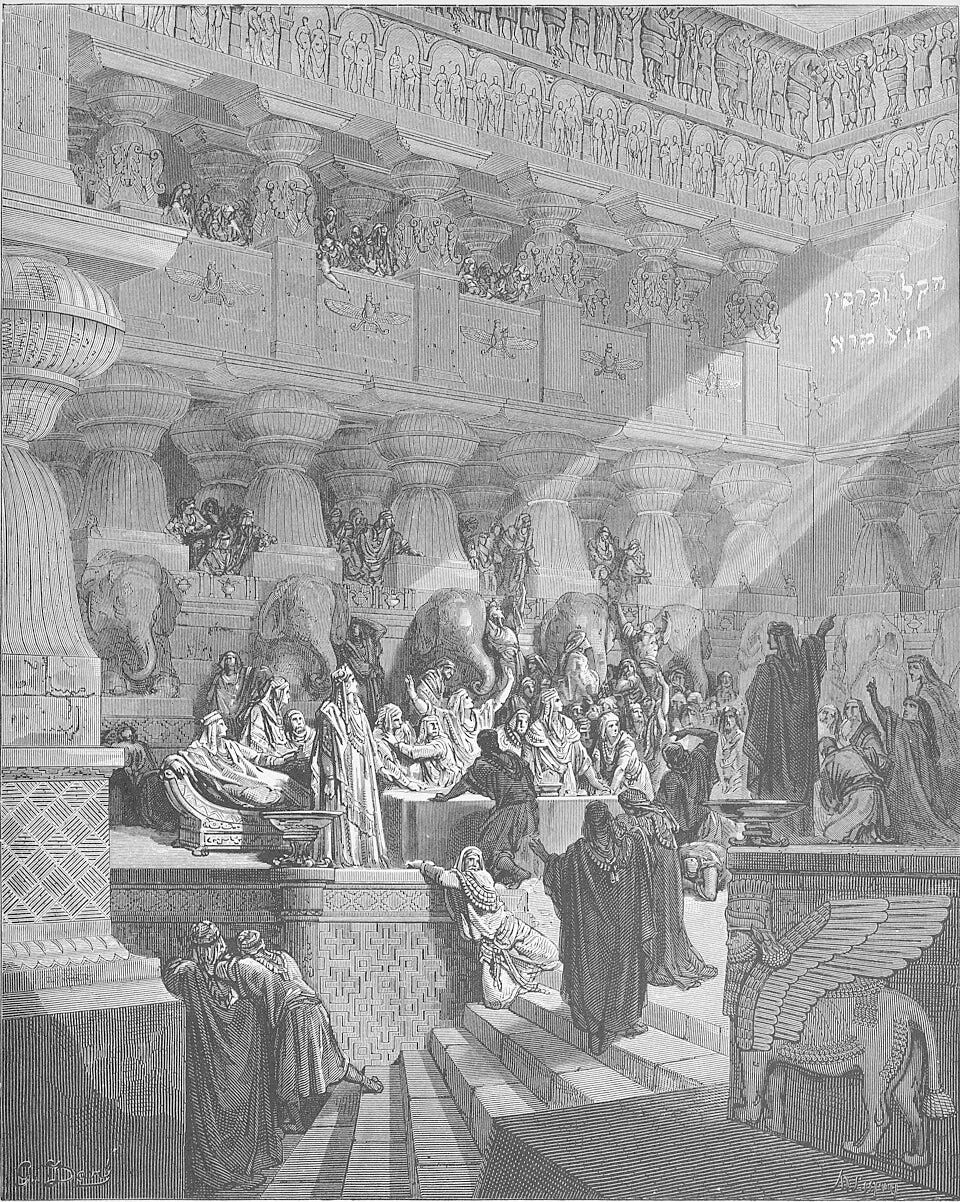
During a great feast hosted by Belshazzar, king of Babylon, he was greatly alarmed when he saw a hand appear and start writing on the wall of his palace (Daniel 5:1-6). He offered his wise men authority over a third of his kingdom if they could read and interpret the inscription, yet none of them could (Daniel 5:7-8).
However, the queen remembered Daniel, who had interpreted the dream of Belshazzar’s father (Daniel 5:10-12). When Daniel was called in, he told the king that he had “not humbled [his] heart…but…exalted [himself] against the Lord of heaven” (Daniel 5:22-23).
The meaning of the inscription on the wall was threefold. First, God was bringing Belshazzar’s kingdom to an end (Daniel 5:26). Second, the king had been “weighed in the balances and found wanting” (Daniel 5:27, ESV). Third, his kingdom would be taken by the Medes and Persians (Daniel 5:28). Belshazzar rewarded Daniel for interpreting the writing on the wall despite the trouble it foretold. That night, Belshazzar was killed, and Darius the Mede took over the kingdom.
Judgment against Belshazzar was immediate and definitive. We do not know when we will “appear before the judgment seat of Christ” (2 Corinthians 5:10). Yet even if it is not as immediate, it is still just as certain.
So let us not be found wanting. Instead, we need to make sure we measure up to the standard the Lord has revealed to us. Knowing that we will be judged according to His word, let us strive to not fall short of it.